
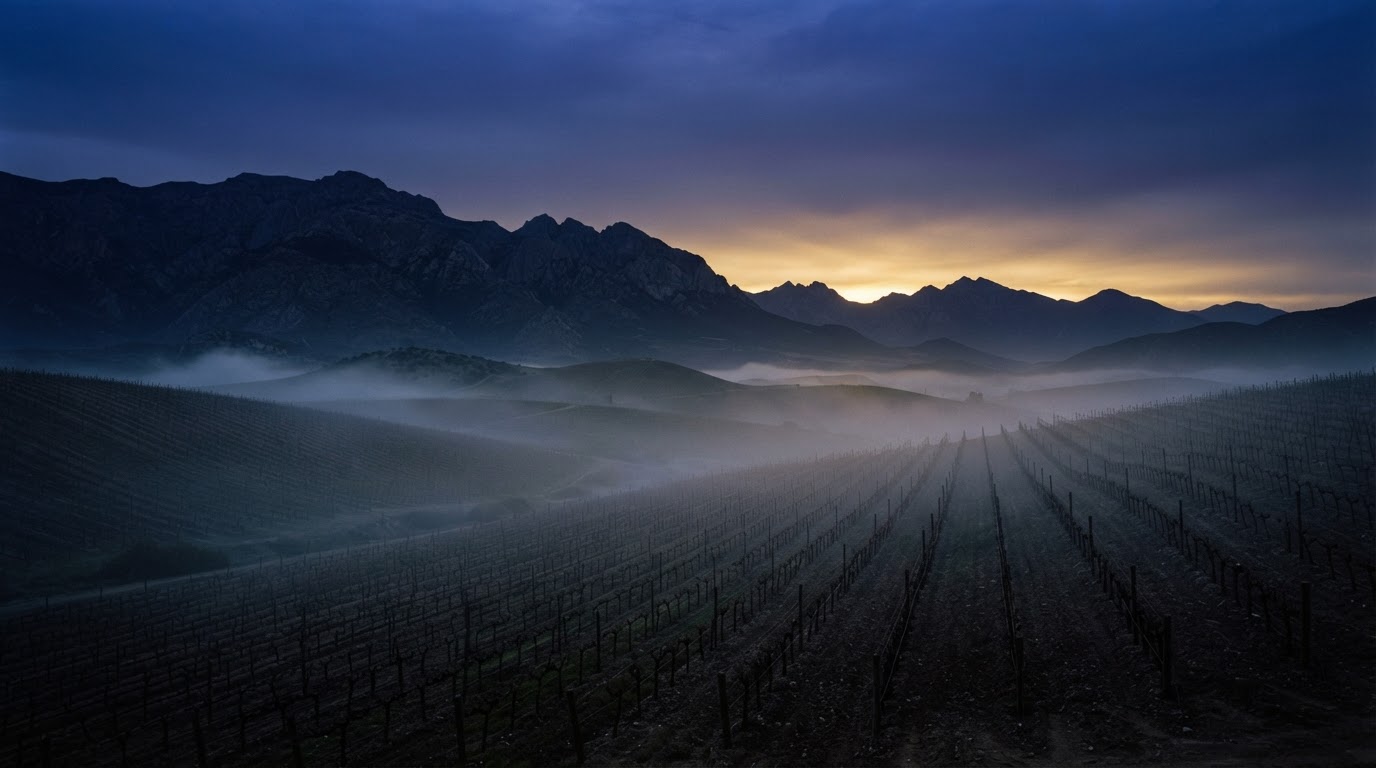
From earth to ritual, every step is an act of reverence. Nothing is rushed; nothing is added that the valley did not already intend.
- I
- II
- III
- IV
- V
The Soil
Year-RoundThe Maule's ancient clays and granitic skeleton are the foundation of every Casa Blaví cluster, earth that holds water through the long dry summer and drains it just enough to force the vine to reach, to concentrate, to speak.
Granite is the secret the Maule whispers only to Carménère. Its mineral skeleton drains the heavy clays, stressing the vine just enough to deepen color and tannin. Our oldest lots grow on these granitic slopes, where roots descend meters into fractured stone, the source of the wine's signature structure and its faint, smoky minerality.
The Climate
Spring – SummerPacific breezes cool the Maule afternoons, and the Andes winds sweep the valley at night, a diurnal shift that lets Carménère ripen slowly, the way it was always meant to.
Carménère is one of the latest-ripening varieties in the world, two to three weeks behind even Cabernet Sauvignon. The Maule's warm days build sugar and the deep crimson that gives the grape its name (from the French carmin); the cold nights preserve the acidity and the aromas of paprika and wild herbs. Pick too early and the pyrazines run green; wait, and the fruit turns to velvet. We wait.
The Harvest
April – MayHand-selected at the edge of autumn, when the clusters have traded their herbaceous edge for black fruit, spice, and the first notes of tobacco, never before.
Each cluster is judged by hand. Carménère's twisted stamens, the tell that, for a century, hid it among the Merlot, also mark an uneven ripening, so we pass through the rows more than once, taking only what is ready. What has not reached its full expression is left for the land. The vendimia in Maule runs late, often into May, and so do we.
The Ageing
12–36 MonthsA cold maceration protects the fresh aromas; a slow, temperature-controlled fermentation draws out color and spice; then the wine rests in French oak until its tannins turn to silk.
We cold-macerate the must to preserve the brightness of paprika and native herbs, the very signature of Carménère, and ferment gently in temperature-controlled tanks with regular punch-downs. Then comes the long rest in French oak: enough to lend structure, never enough to silence the fruit. Some lots see foudres and clay alongside the barrel, so the wine breathes without taking on wood. It rests until its edges soften and its voice finds its full register.
The Sanctification
At BottlingEach premium bottle is adorned with a 24-karat gold bath cross, the last hand to touch it before it leaves the House, a memory, a symbol, a seal of honor.
The cross is the final rite. It is set by hand on each bottle of the Reserva de Honor, a 24-karat gold bath seal that marks the wine as one of the House. To drink the wine is to raise a glass to our ancestors; to keep the cross is to carry them with us, a small ceremony that turns a bottle into a relic.
From the soil to the seal, the bottle is a small ceremony, and the drinking of it, the last rite.